• About Us
  • Services
    • Talent Strategy Services
      • Leadership and Executive Coaching
      • Organizational Design & Workforce Planning
      • Compensation & Incentives
      • Culture, Engagement & Executive Integration
    • Talent Acquisition Services
      • Retained Executive Search
      • Interim & Flexible Leadership (Interim Executive Search)
      • Team & Functional Recruiting
      • Private Equity & Growth Company Solutions
    • Talent Optimization Services
      • Leadership Development Journeys
      • Programmatic Learning & Team Elevation
      • Assessment, Analytics & Talent Toolbox
      • Executive Integration, Onboarding & Performance Health
  • Resources
    • Talent Sequencing Toolbox
    • Blog & Articles
    • Whitepapers & Guides
    • Webinars & Events
  • Contact Us
  • About Us
  • Services
    • Talent Strategy Services
      • Leadership and Executive Coaching
      • Organizational Design & Workforce Planning
      • Compensation & Incentives
      • Culture, Engagement & Executive Integration
    • Talent Acquisition Services
      • Retained Executive Search
      • Interim & Flexible Leadership (Interim Executive Search)
      • Team & Functional Recruiting
      • Private Equity & Growth Company Solutions
    • Talent Optimization Services
      • Leadership Development Journeys
      • Programmatic Learning & Team Elevation
      • Assessment, Analytics & Talent Toolbox
      • Executive Integration, Onboarding & Performance Health
  • Resources
    • Talent Sequencing Toolbox
    • Blog & Articles
    • Whitepapers & Guides
    • Webinars & Events
  • Contact Us
  • About Us
  • Services
    • Talent Strategy Services
      • Leadership and Executive Coaching
      • Organizational Design & Workforce Planning
      • Compensation & Incentives
      • Culture, Engagement & Executive Integration
    • Talent Acquisition Services
      • Retained Executive Search
      • Interim & Flexible Leadership (Interim Executive Search)
      • Team & Functional Recruiting
      • Private Equity & Growth Company Solutions
    • Talent Optimization Services
      • Leadership Development Journeys
      • Programmatic Learning & Team Elevation
      • Assessment, Analytics & Talent Toolbox
      • Executive Integration, Onboarding & Performance Health
  • Resources
    • Talent Sequencing Toolbox
    • Blog & Articles
    • Whitepapers & Guides
    • Webinars & Events
  • Contact Us
  • About Us
  • Services
    • Talent Strategy Services
      • Leadership and Executive Coaching
      • Organizational Design & Workforce Planning
      • Compensation & Incentives
      • Culture, Engagement & Executive Integration
    • Talent Acquisition Services
      • Retained Executive Search
      • Interim & Flexible Leadership (Interim Executive Search)
      • Team & Functional Recruiting
      • Private Equity & Growth Company Solutions
    • Talent Optimization Services
      • Leadership Development Journeys
      • Programmatic Learning & Team Elevation
      • Assessment, Analytics & Talent Toolbox
      • Executive Integration, Onboarding & Performance Health
  • Resources
    • Talent Sequencing Toolbox
    • Blog & Articles
    • Whitepapers & Guides
    • Webinars & Events
  • Contact Us
Diagnostic Framework

The Emerging Leadership Supply Chain Crisis in the Age of AI

AI is not just changing how work gets done. It is re-architecting the organization itself.

One of the most underappreciated consequences is the rapid erosion of middle management and, with it, the traditional pipeline for developing future leaders. This is not a distant scenario. It is a near-term structural shift with long-term implications for leadership supply, enterprise value creation, and private equity outcomes.

Nathaniel Whittemore, in his recent AI Daily Brief podcast episode “The New AI Org Chart” (Apr 12, 2026), surfaced two AI-era operating models worth watching. Building on those observations, this article explores a deeper cause-and-effect: if middle management is increasingly the province of AI, we have disconnected the traditional training ground and pathway for future leadership supply.

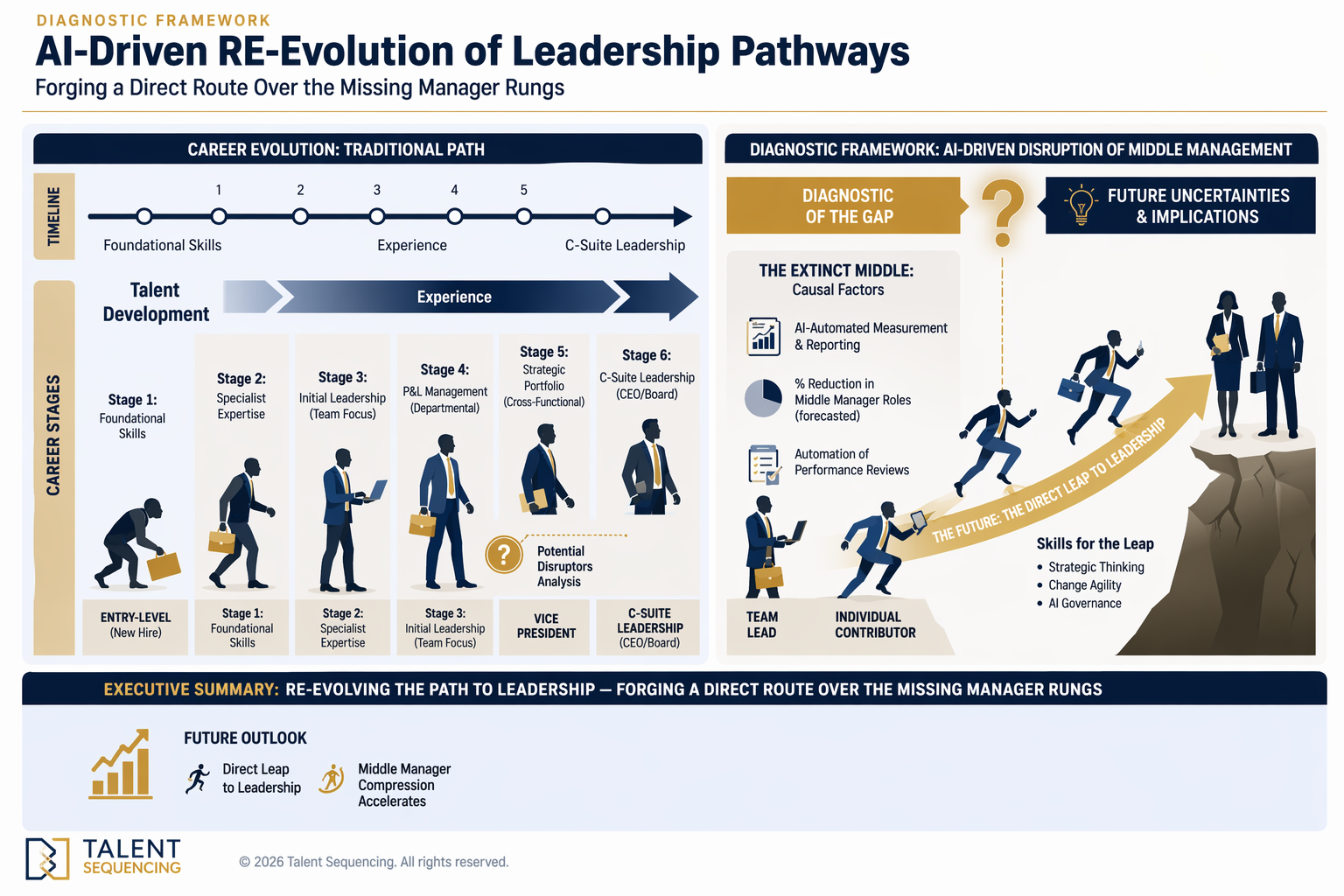
AI-driven re-evolution of leadership pathways framework
Core issue Middle management is shrinking faster than leadership development models are adapting.
Strategic consequence Leadership readiness becomes a value creation constraint, not just a talent concern.
Operating mandate Build leaders intentionally rather than assuming the org chart will produce them.
Executive thesis

The structural shift behind the crisis

Across industries, early signals point to the same pattern: AI reduces the need for information routing, coordination, and reporting layers while decision-making becomes faster, more distributed, and system-enabled.

With the advent and adoption of AI, middle management is likely to rapidly evolve into an endangered species. Yes, the technology sector may be early, but history suggests a familiar trickle-down pattern across the rest of the economy—and in the AI era, where “at the speed of AI” is redefining what “quick” means, tomorrow is arriving much sooner than most leadership teams expect.

AI will do better at most of the primary deliverables of middle management: data collection, analytics, insights, and communication dissemination up and down, and across the org chart.

Most companies use AI to improve efficiency. Far fewer use it to redesign how work actually gets done.

The companies that do will gain a compounding advantage in speed, in decision-making, in execution, and ultimately in value creation.

Emerging models (via Nathaniel Whittemore)

Two operating models worth watching

Whittemore highlights two AI-native operating models that illustrate how coordination and management work are being reimagined in practice.

Model 1

The “Collapsed Middle” model (Block)

A simplified structure built around individual contributors, directly responsible individuals, and player-coaches rather than traditional layers of permanent managers.

  • ICs operate with more autonomy and richer system context.
  • DRIs own cross-functional outcomes temporarily and directly.
  • Player-coaches build while also developing talent.
Model 2

The “Human + Agent” model (Every)

Organizations operate as half-agent systems where AI agents act as parallel team members and a mirrored agent org chart exists alongside human roles.

  • AI becomes a persistent coordination layer.
  • Information moves faster and at lower cost.
  • Support is always on, systemized, and scalable.
Shared implication

The middle becomes structurally optional

Whether the mechanism is DRI ownership or AI agents, the implication is similar: permanent middle management becomes less necessary as a coordination layer.

Leadership pipeline

The broken pathway to the top

The elimination of middle management does not just change org charts. It breaks the primary training ground where future leaders historically learned to lead, hire, prioritize, and decide.

Legacy model

How leaders used to develop

Historically, leadership development followed a predictable path in which each layer served as a learning stage, a testing ground, and a filtering mechanism.

Individual Contributor learn the work
Manager lead people and execution
Director set priorities and allocate tradeoffs
VP run larger systems and teams
C-Suite steer enterprise outcomes
Emerging reality

How the path is changing now

As the middle compresses, organizations are asking individual contributors to leapfrog into senior leadership without the developmental reps that once sat in between.

Individual Contributor deep expertise
Missing link: compressed or extinct middle-management layers
Senior leadership leap higher stakes, less preparation time
Leadership readiness gap Non-linear development Compressed readiness curves
Why now

This is the third strike

Leadership bench strength was already under pressure before AI began collapsing the middle. The current moment, as Talent Sequencing sees it, compounds three separate forces into one larger supply chain problem.

Strike 1

Generational shift

Younger generations watched the personal cost their parents paid for climbing the ladder and have increasingly opted out of the traditional “work harder, get promoted” model.

Strike 2

COVID and remote work

Apprenticeship by proximity vanished. With leaders and managers themselves struggling to lead virtually, the old “watch how it’s done” model of leadership learning largely disappeared.

Strike 3

AI removes managerial necessity

AI, as a digital middleware layer, is poised to take over the bi-directional information gathering, synthesis, and reporting work that used to define much of middle management.

What used to be a leadership development issue is quickly becoming a value creation issue.

Why this matters now
Private equity impact

Why this matters for investors and operators

For private equity-backed businesses, leadership supply is not a soft issue. It directly affects execution speed, decision quality, EBITDA realization, and the pace of value creation.

Execution risk

Fewer ready-now leaders

There are fewer experienced leaders available to step into critical roles at the moment a business needs them most.

Speed risk

Slower decision-making at the top

Inexperienced leadership teams slow prioritization, weaken execution cadence, and reduce organizational responsiveness.

Value creation drag

Leadership gaps create EBITDA leakage

Misalignment, missed growth windows, and delayed execution show up as drag against the value creation plan.

Strategic implication

Leadership supply becomes the new constraint

The next bottleneck may not be capital, strategy, or market conditions. It may be the availability and readiness of leaders.

What comes next

Rebuilding the leadership factory

The old model of learn by watching and grow by promotion is gone. The next model must be intentional, engineered, and accelerated.

1

Structured leadership development early, not late

Identify leadership potential at the individual contributor level and pair it with formal development plus real-world simulation environments.

2

Sandboxed leadership reps

Create controlled environments where emerging leaders can practice decision-making, hiring, conflict management, and accountability without risking enterprise value.

3

Redefine the on-ramp

Future leaders may skip layers, develop non-linearly, and require compressed readiness curves. The pathway itself needs to be redesigned.

4

Industrialize what entrepreneurship does organically

Entrepreneurs often become builder, seller, and leader from day one, but there are not enough of them and many are not suited for scaled environments. Enterprises need a repeatable version of that capability-building engine.

From diagnosis to development

Where VCDI and Talent Sequencing fit

If AI is collapsing the traditional leadership pathway, the practical question becomes how to identify and develop future leaders early enough to avoid value erosion.

Diagnostic lens

VCDI as an early warning system

Talent Sequencing’s VCDI™ helps quantify where leadership gaps are already creating friction across the value creation system.

1
Decision rights and decision velocity
2
Alignment to value creation priorities
3
Execution cadence and accountability
4
Team cohesion, trust, and constructive conflict
Activation engine

Talent Sequencing as the new leadership engine

The mandate shifts from passive development to active leadership engineering aligned directly to business outcomes.

1
Identify early-stage leaders at the IC level with both capacity and desire to lead.
2
Sequence leadership development in parallel with the value creation plan, not after it.
3
Deploy targeted coaching and real-time feedback loops tied to actual business outcomes.
4
Create leadership sandboxes where capability can grow without putting enterprise value at risk.
Final takeaway

The firms that win will engineer leadership

In the AI era, leadership can no longer be treated as a byproduct of hierarchy. It has to become a deliberately engineered asset.

1
Diagnose leadership drag early with VCDI™.
2
Actively build leadership capacity in real time through Talent Sequencing®.
3
Align leadership evolution to value creation rather than to legacy hierarchy.

Credits & sources (for the Block / Every models): “The New AI Org Chart,” Nathaniel Whittemore, The AI Daily Brief: Artificial Intelligence News and Analysis, Apr 12, 2026. All “third strike” analysis and leadership supply chain framing are original perspectives from Talent Sequencing.

© 2026  Talent Sequencing